
Finding the Singing Spruce: Musical Instrument Makers and Appalachia’s Mountain Forests
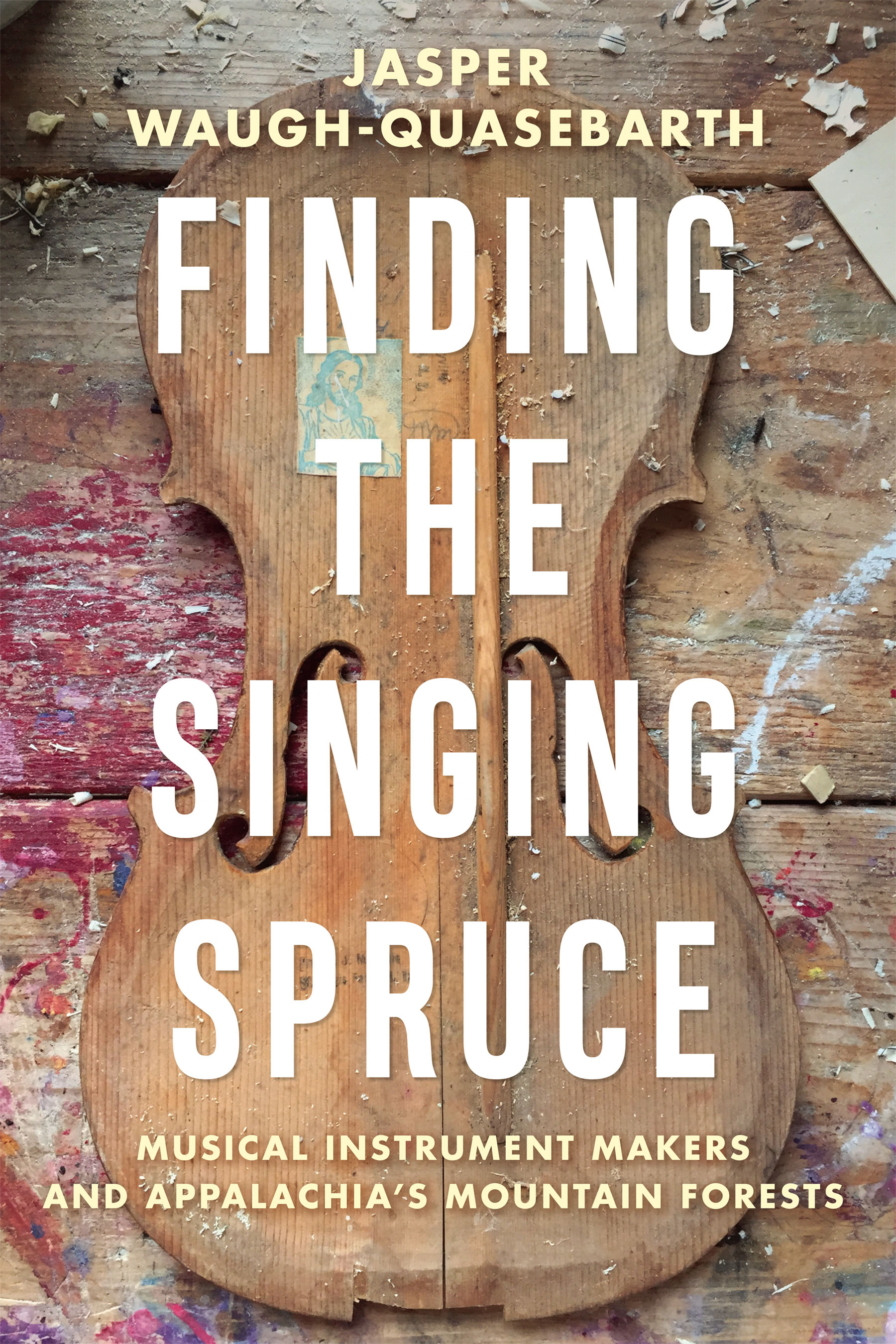

Jasper Waugh-Quasebarth
November 2023
248pp
PB 978-1-959000-00-6
$26.99
eBook 978-1-959000-01-3
$26.99
Sounding Appalachia Series

Jasper Waugh-Quasebarth
November 2023
248pp
PB 978-1-959000-00-6
$26.99
eBook 978-1-959000-01-3
$26.99
Sounding Appalachia Series
Musical Instrument Makers and Appalachia’s Mountain Forests
2023 Weatherford Award Finalist, Nonfiction
How can the craft of musical instrument making help reconnect people to place and reenchant work in Appalachia? How does the sonic search for musical tone change relationships with trees and forests? Following three craftspeople in the mountain forests of Appalachia through their processes of making instruments, Finding the Singing Spruce considers the meanings of work, place, and creative expression in drawing music from wood.
Jasper Waugh-Quasebarth explores the complexities and contradictions of instrument-making labor, which is deeply rooted in mountain forests and expressive traditions but also engaged with global processes of production and consumption. Using historical narratives and sensory ethnography, among other approaches, he finds that the craft of lutherie speaks to the past, present, and future of the region’s work and nature.
List of Illustrations
Acknowledgments
Introduction: “It Will Get in Your Blood”
1. West Virginia’s Musical Instrument Makers
2. Craft at Home in the Mountain Forest
3. A Red Spruce Guitar
4. Bringing Cremona Violins to Lobelia
5. Tonewood from the Old World and the New
Conclusion: Succession in Craft and Forest
Notes
Bibliography
Index
Jasper Waugh-Quasebarth teaches folklore studies at the Ohio State University.
“Finding the Singing Spruce is a nuanced academic contribution to both human and environmental Appalachian studies—but it is also a collection of accessible stories about people, places, and instruments. Waugh-Quasebarth’s experiences, ideas, and work will interest West Virginians, instrument makers, musicians, scholars from various fields of music and culture, and aficionados alike.”
—Aaron Allen, coeditor of Current Directions in Ecomusicology: Music, Culture, Nature
"An exemplary study for folklorists and anthropologists [which] also invites the general public into the complex world of instrument making."
—Mary Linscheid, West Virginia History: A Journal of Regional Studies
Edited by Gloria Howerton and Leanne Purdum
September 2023
224pp
PB 978-1-952271-94-6
$29.99
eBook 978-1-952271-95-3
$29.99
Gender, Feminism, and Geography Series
Law, Policy, and Power
Young people will bear the brunt of the impacts of present and emerging crises occurring at all scales, from the national to the global. This volume brings together scholars and activists from various backgrounds to analyze youth interactions with law and politics, focusing specifically on the US legal landscape. It uses the lens of youth geographies to consider how legal and political systems shape our spaces, and provides leading-edge perspectives through case studies of child labor, compulsory education, asylum claims, criminalization of youth, youth activism, and more.
Of special interest in this volume is the tension between young people as both objects of law and policy and creative agents of change. Despite being directly affected by law and policy, young people are denied access to many legally sanctioned paths to shape them. Yet youth find ways to work within and mold the social, political, and legal spheres and set the stage for alternative futures.
Acknowledgments
Introduction
Gloria Howerton and Leanne Purdum
Part 1: Attempts to Categorize and Manage Youth
1. Working and Schooling: A Critical Geography of Child Labor and Compulsory Education Laws in the Early Twentieth-Century United States
Meghan Cope
2. Protecting Youth: The Dismantling of Youth as a “Particular Social Group” in Contemporary Asylum Law
Kristina M. Campbell
3. “Met with the Full Prosecutorial Powers”: Zero-Tolerance Family Separations, Advocacy, and the Exceptionalism of the Child Asylum Seeker
Leanne Purdum
4. Understanding New York’s Opt-Out Movement: How School Segregation Shaped the Nation’s Largest Resistance to Standardized Testing
Olivia Ildefonso
Part 2: Youth Resistance and Resilience
5. The Coming of the Superpredators: Race, Policing, and Resistance to the Criminalization of Youth
Marsha Weissman, Glenn Rodriguez, and Evan Weissman
6. BreakOUT!: Queer and Trans of Color Activism in New Orleans
Krista L. Benson
7. Black Youth Resistance to Policies, Practices, and Dominant Narratives of the St. Louis Voluntary Desegregation Plan
Jerome E. Morris and Wanda F. McGowan
8. The Tribunal of the Future: Youth, Responsibility, and Temporal Justice in US Climate Change Litigation
Mark Ortiz
Contributors
Index
Gloria Howerton is an assistant professor in the department of geography and anthropology at the University of Wisconsin–Eau Claire. Leanne Purdum is a visiting assistant professor in the law, politics, and society program at Drake University.
“This volume is one of the only of its kind, and its engagement with geography, the law, and policy—while reframing children and childhood—stands to make many contributions and interventions in the field.”
Nicole Nguyen, author of A Curriculum of Fear: Homeland Security in US Public Schools
Sol Gittleman
September 2023
200pp
PB 978-1-959000-04-4
$18.00
eBook 978-1-959000-05-1
$10.00
Distributed for Vesto Books
The Improbable History of American Higher Education
“Hardly a day passes without reference to some scandal, fraud, intellectual or moral failure, or other ill associated with American academic institutions,” writes Sol Gittleman in his bracing new book, An Accidental Triumph. “If American higher education is such a failure, why are students and scholars from all over the world still so eager to secure a place in one of these institutions? Is American higher education a disaster or the envy of the world?”
Gittleman confronts this contradiction in this dynamic mix of history, analysis, and personal reflection. An Accidental Triumph tells the engaging story of how American higher education evolved from a patchwork of seminaries in the early nineteenth century into the world’s leader in research by the middle of the twentieth. Gittleman links this fascinating story to his own fifty-year academic career, which coincided with an explosive rise in enrollment, spurred by the GI Bill, and an unparalleled postwar boom in faculty hiring, prompted by massive new federal support for academic research from organizations such as the National Science Foundation.
Writing with authority, frankness, and unfailing wry good humor, Gittleman surveys the triumphs, tragedies, and tensions of the history of American higher education. Despite the relentless criticism, Gittleman finds good reason to remain optimistic about the future of teaching and research at the college and university level in the United States.
To come
Sol Gittleman is the Alice and Nathan Gantcher University Professor Emeritus at Tufts University, where he taught from 1964 until his retirement in 2015. He served as provost from 1981 to 2002 and has received many awards, fellowships, and honorary degrees for his teaching and service. He is the author of six books, including An Entrepreneurial University.
“There’s no more important story to be told at this moment in America then why higher education matters. And there’s no more adept and engaging storyteller than Sol Gittleman.”
Larry Tye, New York Times bestselling author of Satchel and Demagogue
“An Accidental Triumph, Sol Gittleman’s fast-paced, highly personal history of American higher education, reflects his many years of leadership at Tufts University and his ability to weave together the relevant literature, from scholarly work to journalistic commentary. All who know Gittleman will recognize his distinctive voice and strongly held views. And all who care about academia will benefit from his sharp insights and passion as an educator.”
Richard Freeland, author of Academia’s Golden Age: Universities in Massachusetts, 1945–1970 and former President of Northeastern University
“A brief, spirited, thoroughly engaging account of the evolution of American higher education from its earliest origins in the fledging seminaries of the colonies to its world pre-eminence in the 21st century. Sol Gittleman crafts his account on the basis of deep immersion in the literature on higher education, liberally laced with his own perspectives from a half century of experience as a faculty member and provost at Tufts University. He is both a cheerleader for American colleges and universities and a realist about the ways in which American higher education has opened itself to a raft of critiques about its efficacy and integrity. Well worth a careful read.”
Nancy Weiss Malkiel, author of “Keep the Damned Women Out”
: The Struggle for Coeducation and professor of history emeritus at Princeton University
“Sol Gittleman is a gifted scholar, professor, and academic leader whose graceful book tells the many stories of continuity and conflict in the long history of American higher education. His critical eye and good humor are an effective combination to provide insightful accounts of exclusion and inequities along with an American consensus in creating our remarkable colleges and universities.”
John Thelin, author of A History of American Higher Education and university research professor at the University of Kentucky
“An Accidental Triumph has charm. Sol Gittleman is a great storyteller and his book carries a personal touch. He has genuine affection for the institutions of which he writes and in which he has lived his life, even as he is clear-eyed about its checkered past.”
Peter J. Dougherty, former Director, Princeton University Press
“Sol Gittleman’s grasp of history, his interpretive skills, and his sense of humor—all on prominent display in An Accidental Triumph—have convinced me that no one is better suited to tell this provocative story.”
Daniel Okrent, author of Last Call and The Guarded Gate
“An extraordinary accomplishment.”
Jonathan Wilson, author of The Red Balcony and Fletcher Professor of Rhetoric and Debate Emeritus at Tufts University
Use code ABWH22WVUP30 at checkout
Now through December 31, 2022
Davon Loeb
February 2023
280pp
PB 978-1-952271-74-8
$21.99
eBook 978-1-952271-75-5
$21.99
A Lyrical Memoir
The In-Betweens tells the story of a biracial boy becoming a man, all the while trying to find himself, trying to come to terms with his white family, and trying to find his place in American society. A rich narrative in the tradition of Justin Torres’s We the Animals and Bryan Washington’s Memorial, Davon Loeb’s memoir is relevant to the country’s current climate and is part of the necessary rewrite of the nation’s narrative and identity.
The son of a Black mother with deep family roots in Alabama and a white Jewish man from Long Island, Loeb grows up in a Black family in the Pine Barrens of New Jersey as one of the few nonwhite children in their suburban neighborhood. Despite his many and ongoing efforts to fit in, Loeb acutely feels his difference—he is singled out in class during Black History Month; his hair doesn’t conform to the latest fad; coaches and peers assume he is a talented athlete and dancer; and on the field trip to the Holocaust Museum, he is the Black Jew. But all is not struggle. In lyrical vignettes, Loeb vibrantly depicts the freedom, joys, and wonder of childhood; the awkwardness of teen years, first jobs, first passions. Loeb tells an individual story universally, and readers, regardless of subjectivity and relation, will see themselves throughout The In-Betweens.
A Love Story
On I-85 South
My Mother’s Mother
Bath Time
The Reconstruction of a Slave
At Church
Like Gladiators
Drinking a Colt 45
Throw the Football
A Roll of Duct Tape
Summer Thunderstorms
Aunt Sammy
Alabama Fire Ants
Don’t Open the Door
The Settlers Inn
To Be a Man
Patricide and Boot Shines
With My Dad
Fighting for the Tree
Weekend Weather
O. J. and the Wax Museum
Steve Urkel, Kick the Ball
Before Cell Phones
Between Walls at a Friend’s House
But I Am Not Toby
Thoughts on Hair
The Angels of the Paint
Suicide on the Triples
Shopping with Kris
The Jumps
Not the Worst of Boys
5-Series BMW
A Back Seat and a Fire Pit
Morning Noise
Quitting Meant Back to Babysitting
After-School Basketball Game
The Best Dancer
The Black Jew
Something about Love
Visitations with My Father
For My Brother
Living in a Studio Apartment
The Makings of a Gym Rat
In-Between Sirens
A Small Lesson on Loitering
On the Confederate Flag
Retirement
Acknowledgments
Davon Loeb is an assistant features editor at The Rumpus. He earned an MFA in creative writing from Rutgers University–Camden and has had work published in Catapult, Ploughshares, Joyland, PANK, and elsewhere. He lives in New Jersey. Learn more at davonloeb.com.
“Utterly captivating and resonant, The In-Betweens deserves a top spot on your bookshelf.”
Chicago Review of Books
“This gorgeously told 'lyrical memoir' recounts Loeb’s curious, difficult, joyous journey to find a place in the world in light of his Southern Black and Long Island-Jewish heritage.”
Philadelphia Inquirer
“Resonant. . . . Engagingly delivered, candid reflections on heritage and identity.”
Kirkus Reviews
“Ideal for those interested in descriptive, insightful stories about what it is like to not quite fit in anywhere, to inhabit many spaces at once, and to be challenged with the formation of one’s own identity in a sometimes chaotic and contradictory environment.”
Library Journal
“Loeb’s writing is artful. . . . One must get to know Loeb slowly, one memory at a time.”
Jewish Book Council
“Rich, evocative, and surprising.”
Marissa Higgins, Daily Kos
“While the memoir is masterfully told—Loeb employs a variety of craft techniques that have a powerful effect—what makes The In-Betweens so special is the thoughtfulness Loeb brings to his work.”
The Rumpus
“[Loeb] dances to a slow, beautiful ballad on every page. His story will move any reader, but it’s the craft of his work that truly shines.”
Debutiful
“With its keen attention to language and its moving portrayal of boyhood and belonging, The In-Betweens has earned its place alongside the greats of lyrical, coming-of-age nonfiction.”
The Adroit Journal
“Loeb’s debut memoir crackles with light, breaking open each superb chapter to uncover a memorable and gripping origin story.”
Aimee Nezhukumatathil, author of World of Wonders
“Sentence to sentence, The In-Betweens is awake to the awe of being in a body and the danger of negotiating a culture that wants to drive space between us, inside us. Davon Loeb is writing to stay alive under the harshest conditions, and he has given us a brilliant, devastating book.”
Paul Lisicky, author of Later: My Life at the Edge of the World
“Confession, manifesto, bildungsroman, and prayer, The In-Betweens is a meditation on bruise and healing. Loeb’s struggles become snapshots of how transformation occurs even where shards have been piled, where one waits ‘for something to happen, like flashes of red and blue and sirens pulsing.’ A truly extraordinary new voice.”
Roy G. Guzmán, author of Catrachos
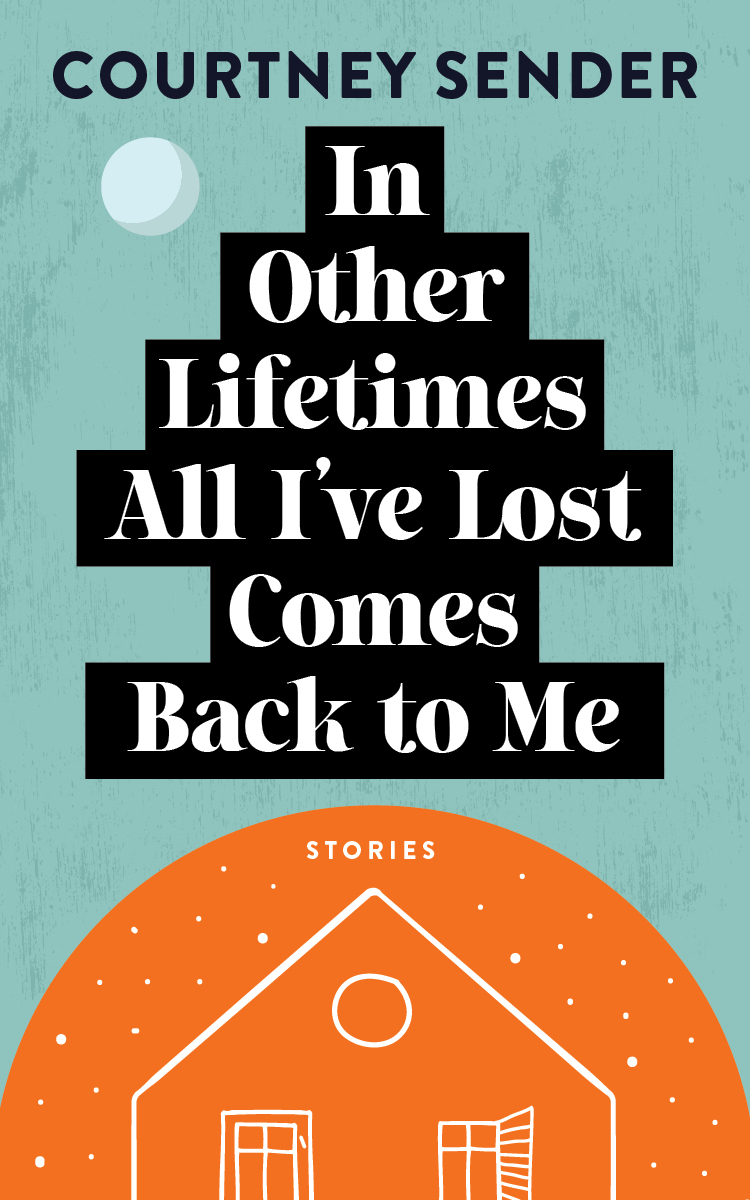
Courtney Sender
March 2023
208pp
PB 978-1-952271-78-6
$19.99
eBook 978-1-952271-79-3
$19.99
Stories
Populated with lovers who leave and return, with ghosts of the Holocaust and messages from the dead, Courtney Sender’s debut collection speaks in a singular new voice about the longings and loneliness of contemporary love. The world of these fourteen interlocking stories is fiercely real but suffused with magic and myth, dark wit, and distinct humor. Here, ancient loss works its way deep into the psyche of modern characters, stirring their unrelenting lust for life.
In “To Do With the Body,” the Museum of Period Clothes becomes the perfect setting for a bloody crime. In “Lilith in God’s Hands,” Adam’s first wife has an affair in the Garden of Eden. And in the title story, a woman spends her life waiting for any of the men who have left her to come back, only to find them all at her doorstep at once.
For readers of Elena Ferrante, Nicole Krauss, and Carmen Maria Machado, and for anyone who has known love and loneliness, In Other Lifetimes All I’ve Lost Comes Back to Me is a wise and sensual collection of old hauntings, new longings, and unexpected returns, with a finale that is a rousing call to the strength we each have, together or alone.
In Other Lifetimes All I’ve Lost Comes Back To Me
Black Harness
For Somebody So Scared
Only Things We Say
Epistles
An Angel on Stilts
The Docent
I Am Going to Lose Everything I Have Ever Loved
Lilith in God’s Hands
To Lose Everything I Have Ever Loved
To Do With the Body
From Somebody So Scared
Missives
A New Story
Acknowledgments
Courtney Sender’s writing has appeared in the New York Times’ Modern Love, the Atlantic, the Kenyon Review, American Short Fiction, and Tin House, among others. A MacDowell and Yaddo fellow, she holds an MFA from the Johns Hopkins Writing Seminars and an MTS from Harvard Divinity School. She currently lives in the Boston area.
“Sender shifts between stories of love—between lovers, friends, family, ghosts—and the great looming shadow of the Holocaust, making a deep and howling portrait of longing and loneliness.”
Boston Globe
“Sender’s willingness to explore primal hurts makes her fiction compelling. . . . A distinctive debut from a promising author.”
Kirkus Reviews
“Sender’s intimate worlds explore the hollows of the real and imagined, bringing to life emotions and connections too unwieldy to define or restrain.”
Booklist
“A stunner from the very first page.”
Deesha Philyaw, author of The Secret Lives of Church Ladies, in the Millions
“A profound and deeply funny examination of loneliness in many of its forms.”
Emma Copley Eisenberg in Electric Lit
“This book is fierce. This book is rowdy. This book makes you think about all the relationships in your life that have not panned out as you might have hoped.”
Barrelhouse
“Brooding, poignant. . . . The sharp humor and imagination in these stories helps to temper the aching loneliness of people who are in various phases of losing, rejecting, or longing for love.”
Foreword Reviews
“Courtney Sender hooks us with her singular magic. . . . Brilliantly aching and haunting.”
Sara Lippmann, Lilith blog
“Sender matches the light topic of youthful lost love with the extreme heft of the Holocaust . . . and comes up with a miraculous balance between the personal and the universal.”
Ann Patchett, author of The Dutch House
“Wholly original, lyrical, fierce, these stories confound expectations at every turn. Courtney Sender writes about passion and loneliness, faith and longing, heaven and hell with a clear eye and a compassionate wit. This collection expands and celebrates, even as it sometimes upends, what it means to tell a love story.”
Alice McDermott, author of The Ninth Hour
“Courtney Sender’s stories are fierce and tender, exploring the urgency of desire, the restlessness of longing, and the way that both trauma and the will to survive can be a haunting inheritance. Sender moves gracefully between the surreal and the everyday, capturing the way romantic love can be at once impossibly strange and mercifully familiar.”
Danielle Evans, author of The Office of Historical Corrections
“Trust is the soul of these stories, and it flows both ways: the trust Courtney Sender has in her reader and the trust the reader feels deeply and truly in the hands of such a generous, intelligent, offbeat, singular writer. These stories, structured in an utterly original way, are rare and real; they get under your skin.”
Elisa Albert, author of Human Blues
“Reading these stories is like hearing a series of songs you love—the rhythm, the feeling, the physicality, the words! Literary rock ’n’ roll.”
Aimee Bender, author of The Butterfly Lampshade
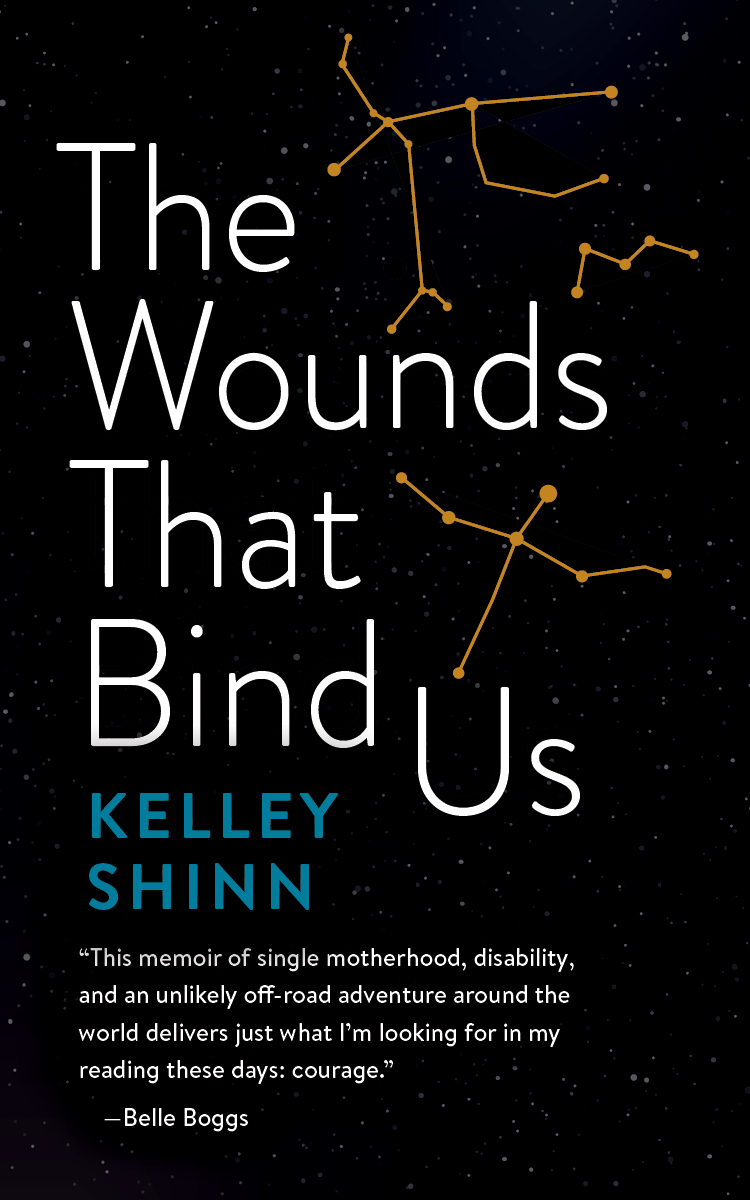
Kelley Shinn
June 2023
296pp
PB 978-1-952271-86-1
$21.99
eBook 978-1-952271-87-8
$21.99
The Wounds That Bind Us is the improbable true story of Kelley Shinn, an orphan at birth who loses her legs at the age of sixteen to a rare bacterial pathogen. She becomes an avid off-road racer and, as a single mother, attempts to drive around the globe in a Land Rover with her three-year-old daughter in tow to bring light to the plight of land mine survivors. With unflinching honesty, exceptional lyricism, and biting humor, Shinn (“that’s two Ns and no shins”) takes readers on a wild journey—literal and emotional—filled with striking characters and landscapes, heartbreaks, and hard-won insights, ultimately arriving at a place of profound redemption.
Told with the energy and intensity of the adventure story it is, this terrifically rich and nuanced examination of a life is also a careful meditation on renewal—a remapping of the world. Guided by the narrator’s keen introspection and her ability to look resolutely at harrowing sorrows and still find hope, joy, and meaning, The Wounds That Bind Us will resonate deeply, long after the last page.
Kelley Shinn lives on Ocracoke, North Carolina, a remote island twenty-six miles from the coast. Her writing has appeared in the New York Times, Fourth Genre, Intima: A Journal of Narrative Medicine, and elsewhere.
“A harrowing memoir. . . . Readers may not want to follow in [Shinn’s] footsteps, but they will never be bored with her as a companion.”
Kirkus Reviews
“Simultaneously empowering and disconcerting. . . . Ultimately, one comes away from this book with an appreciation for the beauty of broken things.”
Southern Review of Books
“It is impossible to put down this book. The story of Kelley Shinn’s often dangerous but always thrilling and adventurous life will leave you breathless and awed. The courage, compassion, and joy with which Shinn lives her life is inspiring. She is the person every parent would want to see their child grow to be, the mother every kid wishes they had.”
Jessica Anya Blau, author of Mary Jane
“This memoir of single motherhood, disability, and an unlikely off-road adventure around the world delivers just what I’m looking for in my reading these days: courage. That, and fine writing, unforgettable characters, suspense, humor, tenderness, and a profound yet humble sense of moral purpose. Kelley Shinn is a marvel, and her book, despite its pain, makes a better world feel possible.”
Belle Boggs, author of The Art of Waiting: On Fertility, Medicine, and Motherhood
“The Wounds That Bind Us offers perennial relevance in a fresh literary manner. Kelley Shinn invites the reader, the voyeur, the accidental tourist into a world that is a brilliant jewel box of precise, complex, and beautiful turns, with language that bites and soothes the wound in the same stroke. These personal narratives, written with a deliberate genius of craft, usher an arresting memoir that lifts heavy veils and becomes bountiful succor for the parched truths we share.”
Jaki Shelton Green, North Carolina Poet Laureate
“A beautiful book about how the things we love are torn away from us and about the ways we hold on. Shinn is an anatomist of velocity. Thrilling.”
Thomas Beller, author of J.D. Salinger: The Escape Artist
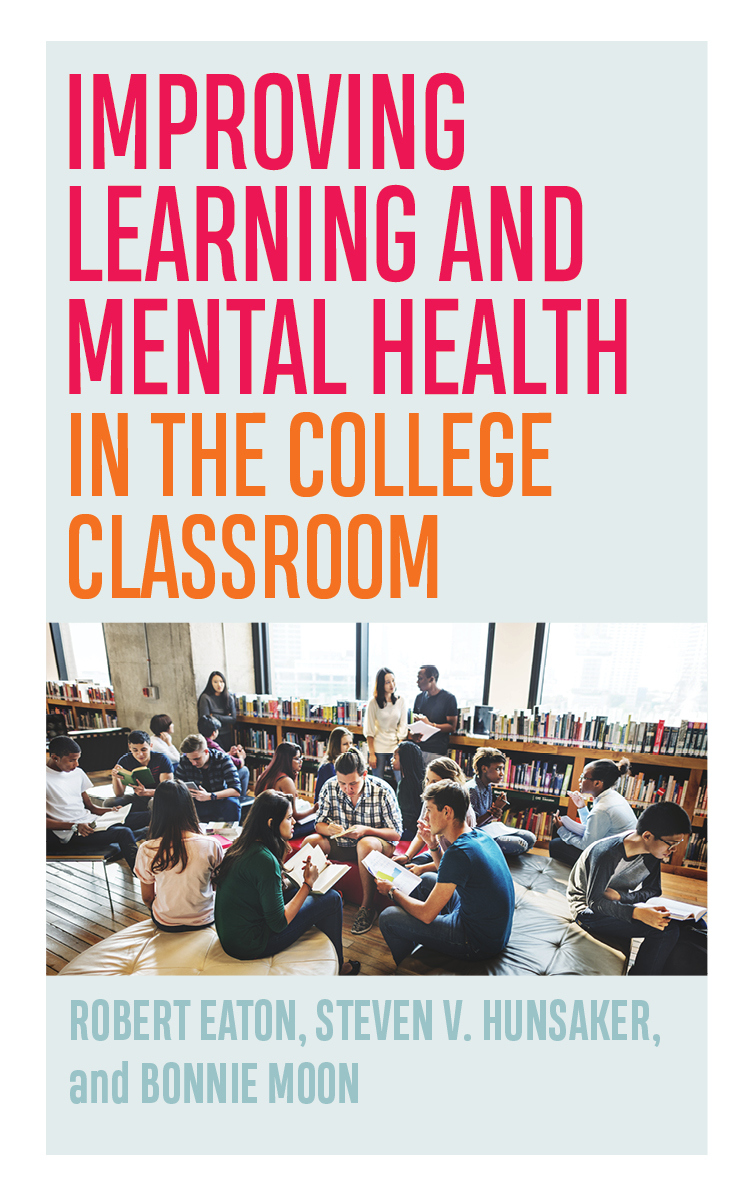
Robert Eaton,
Steven V. Hunsaker,
and Bonnie Moon
Teaching and Learning in Higher Education Series
Mental health challenges on college campuses were a huge problem before COVID-19, and now they are even more pronounced. But while much has been written about higher education’s mental health crisis, very little research focuses on the role played by those on campus whose influence on student well-being may well be greatest: teachers. Drawing from interviews with students and the scholarship of teaching and learning, this book helps correct the oversight, examining how faculty can—instead of adding to their own significant workloads or duplicating counselors’ efforts—combat student stress through adjustments to the work they already do as teachers.
Improving Learning and Mental Health in the College Classroom provides practical tips that reduce unnecessary discouragement. It demonstrates how small improvements in teaching can have great impacts in the lives of students with mental health challenges, while simultaneously boosting learning for all students.
Receive a 30% discount on orders of 10 or more copies of this title with code HIGHEREDBULK30 at checkout.
Preface
Introduction
1. Why Anxiety and Depression Matter for Learning
2. Become Natural Mentors
3. Design Courses with Students with Mental Health Challenges in Mind
4. Awaken Students’ Innate Drive to Learn
5. Foster Emotional Resilience
6. Build Community
7. Avoid Pitfalls with Active Learning
8. Promote Wellness Practices
Conclusion
Notes
Bibliography
Index
Robert Eaton is a professor of religious education, Steven V. Hunsaker is a professor in the department of languages and international studies, and Bonnie Moon is a professor of mathematics, all at Brigham Young University–Idaho.
“This is a necessary book for anyone who teaches in higher education. By weaving together research and practice, the authors show faculty how small steps we take can contribute to improved learning and mental health for our students.”
Peter Felten, coauthor of Relationship-Rich Education: How Human Connections Drive Success in College
“Mental health challenges for college students are at a crisis point, and this book is a must-read for instructors. Readers will gain understanding of how mental health issues can obstruct learning, and of how to build a toolkit of research-based teaching practices designed to mitigate harmful stressors and promote learning. Intentional design choices lend structured support to those who need it most, and can benefit all students during the transformative college years.”
Jenny Frederick, Yale University
“A readable synthesis of the research into student mental well-being. The authors provide plenty of relevant and actionable advice on how faculty can effectively incorporate attention to mental health into their daily teaching practices.”
Jason Pickavance, Salt Lake Community College
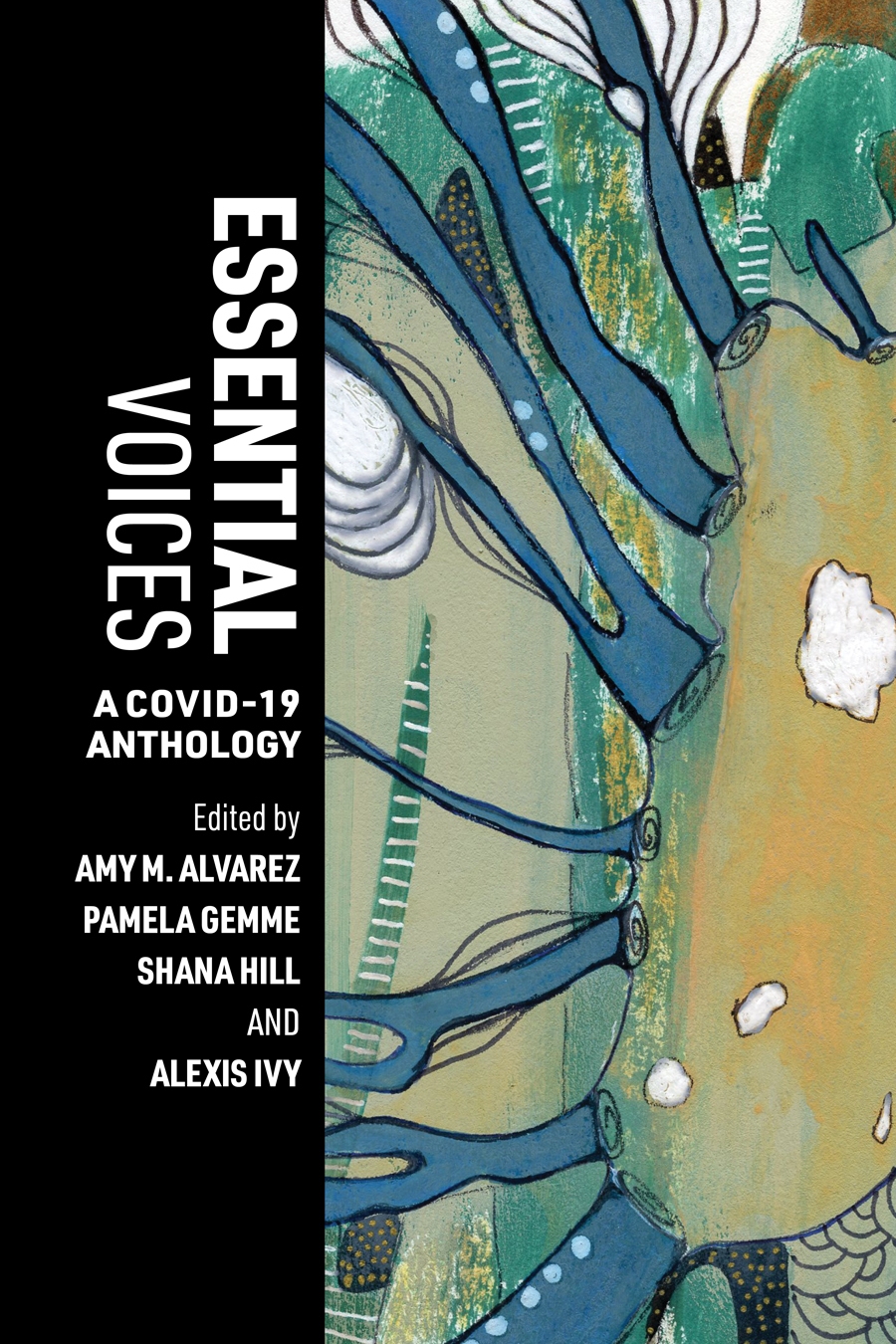
Edited by Amy M. Alvarez, Pamela Gemme, Shana Hill, and Alexis Ivy
July 2023
304pp
PB 978-1-952271-88-5
$26.99
eBook 978-1-952271-89-2
$26.99
Borderless Series
A COVID-19 Anthology
Bringing together artwork, creative nonfiction, fiction, and poetry, Essential Voices shares the perspectives of people from vulnerable populations as they were affected by COVID-19 in 2020, before the release of the vaccine. The pieces in this volume represent a range of writers and artists, some from international locations, whose work may be less likely to be seen because of race, ethnicity, or current legal status. Contributors include individuals who identify as BIPOC, LGBTQIA+, or seniors; those who are immunocompromised or undocumented; those working in medicine, food service, factories, and sanitation; and parents who were unable to work from home, along with individuals who were being held in correctional facilities or facing mental health concerns. This multigenre collection preserves the history of the pandemic by documenting and publishing these essential voices.
Essential Voices will be of interest to readers who want to consider the diverse lived experiences of people during the pandemic when outcomes were most uncertain. It will also be useful for teachers, students, activists, and policy makers in a variety of settings, including government, hospitals, prisons, homeless shelters, colleges, art schools, and secondary schools.
List of Illustrations
Foreword | Maria del Guadalupe Davidson
Introduction
Acknowledgments
Fear: It lives in droplets
Monster under Me
Fiction | Nathan Blalock
Table of Contents for a Manual of Pandemic Response Protocols
Poetry | Rasha Abdulhadi
The Worst of Times
Essay | Frances Ogamba
Essentials
Poetry | Maria James-Thiaw
Recipe for Troubled Times
Poetry | Linda Parsons
Night Guard
Poetry | Linda Parsons
Pandemic Pandemonium
Poetry | Kenneth Moore
Even the Robins Know
Poetry | Robert Okaji
Distance: As we moan into the phone
How Corona Evolves or Makes Us Evolve, or We Have to Evolve Together
Poetry | Xiaoly Li
Sequestered Alone
Poetry | Joan Hofmann
To whom it may concern,
Letter and Poetry | Alyce Copeland
Love in the Time of Corona
Poetry | John Cuetara
What We Know about the Fatalities
Fiction | Lisa Michelle Moore
Do Lockdowns Ever End?
Poetry | Diego Islas
Wish You Were Here
Poetry | Joan Goodreau
Comfort
Poetry | Celeste Blair
Didn’t We Once Call It Love?
Poetry | E. Ethelbert Miller
The Cheat
Poetry | Rayna Momen
How I’ve Survived This Long, Part 3
Poetry | Kasha Martin Gauthier
What it’s like to get married in prison during a pandemic
Essay | Christopher Blackwell
Mask: A parachute that catches my breath
Invisi dis ability in COVID Times
Essay | Catherine Young
Corona Spring
Poetry | Deborah DeNicola
Unmasked
Poetry | Faiza Anum
The Fabric of Society
Fiction | Alice Benson
Masked
Poetry | Christine Rhein
Melt Down
Poetry | Mary K O’Melveny
May 6, 2020
Poetry | Kevin McLellan
Barriers
Essay | Robbie Gamble
from The Quarantinas
Poetry | Stephanie Lenox
Labor: Warnings on the floor
Bezos Knows
Poetry | Ranney Campbell
We Are Family: A Lesson Learned as an On-line English Teacher during COVID-19
Essay | Maya Lear Brewer
Line Speed
Poetry | Ben Gunsberg
Staying Socially and Politically Active while Socially Distancing: Making the Issues around COVID-19 Part of One’s Activism
Essay | C. Liegh McInnis
Essential Medical Workers Are to Report to Duty
Poetry | Michele Bombardier
These Hands
Fiction | Z. S. Roe
Postcard from Pandemic
Poetry | Robert Okaji
A Classroom Hums in Wait.
Poetry | Vanessa Chica Ferreira
Sickness: My stomach charlie-horsed
My COVID Story
Essay | Brett L. Massey
Essentially Unseen
Poetry | Lavinia Kumar
Nudge
Poetry | Phrieda Bogere
Elegy
Poetry | Bianca Alyssa Pérez
I Cut Up My Hillary T-shirt to Make a COVID Mask
Poetry | Joan E. Bauer
A Story of Constantine, COVID-19, and Pandora
Fiction | Waliyah Oladipo
New Age
Poetry | Robert J. Levy
Alcohol Woman
Poetry | Deidra Suwanee Dees
Grief: Interjected like a comma
Elegy, Interrupted
Poetry | Emily Ransdell
My Mother Whispers, Doesn’t He Look So Peaceful
Poetry | Bianca Alyssa Pérez
A Sonnet for the Living
Poetry | Bianca Alyssa Pérez
#covidclarity
Essay | Marcelle Mentor
Trapped
Poetry | Deidra Suwanee Dees
Love, Coronavirus
Poetry | Lisa Suhair Majaj
A Poet Attempts to Homeschool, Week 6: Fractions
Poetry | Kasha Martin Gauthier
Evaporating Villanelle during a Time of Pandemic
Poetry | Jen Karetnick
A Day in the Life
Essay | Eric Ebers
What You Want to Say
Poetry | Maria Rouphail
Zoom Funeral
Poetry | Laura Glenn
For Jon, Who Died Because of Time
Poetry | Rayna Momen
Survival: Remember every surface you touch
Essential Nonessentials in Lockdown
Poetry | Katy Giebenhain
The Eaters
Fiction | Danielle Lauren
Off-Script
Poetry | Monserrat Escobar Arteaga
Heroes
Fiction | Mark Brazaitis
15 Mar 2020—A (a roll in the hand is worth two on the shelf) Haiku
Poetry | Peter Joel
We Will Sing of Gone Bodies Some Days from Now
Poetry | Blessing Omeiza Ojo
In Times of Quarantine
Poetry | Rosalie Hendon
Halmoni’s Kimchi Pancakes
Recipe | Elia Min
COVID Curriculum
Essay | Dominique Traverse Locke
Monkeys
Poetry | Fabiyas M V
Justice and Reckoning: Colonial co-morbidities
How to Make White Supremacy Generative/How to Survive a Pandemic
Essay | Ahimsa Timoteo Bodhrán
Blackout
Poetry | Thomas Beckwith
The Marrow-Sucking Grip of Immigration Injustice
Poetry | Kim Denning
White
Poetry | Roan Davis
we’ve been here before
Poetry | Liseli A. Fitzpatrick
Crosstown
Poetry | Ahimsa Timoteo Bodhrán
My Uncertain Story
Essay | Noe Hernandez
Em Ontvlecetv / Invaded
Poetry | Deidra Suwanee Dees
POV
Poetry | Jameka Hartley
The Home of the Brave
Poetry | David Antonio Reyes
Things I Never Told You
Poetry | Steve Ramirez
Environment and Place: Let the river turn the stone
Lines before Lockdown
Poetry | Lisa Suhair Majaj
hymn
Poetry | Caroline Furr
May Shivers
Poetry | Lukpata Lomba Joseph
For the emptiers have emptied them out
Poetry | Alan Smith Soto
While the World Fell Apart around Us
Poetry | Aimee Nicole
COVID Spring Comes to Southeast Pennsylvania
Poetry | Kenneth Pobo
2020
Poetry | Yuan Changming
Folded Up
Poetry | donnarkevic
Social Distance
Poetry | Fred Shaw
Austin
Poetry | Jeffrey Taylor
Hope: Beyond sorrow there’s a gardenia tree
During quarantine, I embrace myself as a long-hauler,
Poetry | Jen Karetnick
Magdalena
Poetry | Deborah “Deby” Rodriguez
Too Loud to Sleep
Essay | Natalie Mislang Mann
When the Games Return
Poetry | E. Ethelbert Miller
Wasted
Essay | Celeste Blair
This Is Not the End of the World
Poetry | Darius Atefat-Peckham
Touch Screen
Fiction | Mohini Malhotra
Notes
Contributors
About the Editors
Amy M. Alvarez is an Affrilachian poet and professor living in Morgantown, West Virginia.
Pamela Gemme is a poet, artist, and creative writing tutor from Massachusetts.
Shana Hill is a poet and founder of Poetica Pastor. She lives in Somerville, Massachusetts.
Alexis Ivy is a poet and outreach advocate for homeless people in Cambridge, Massachusetts.
“The work is emotionally moving. The attention to the quotidian, lived experiences of those affected offers unique insights into a global catastrophe that has turned precious lives and deaths into statistics. . . . An important cultural response.”
Darius Bost, author of Evidence of Being: The Black Gay Cultural Renaissance and the Politics of Violence
“This is a text of powerful firsthand accounts that capture the current context in critical and intersectional ways that are attentive to how individual lives are shaped by structural realities. It is important that these voices are engaged.”
Nana Osei-Kofi, Oregon State University
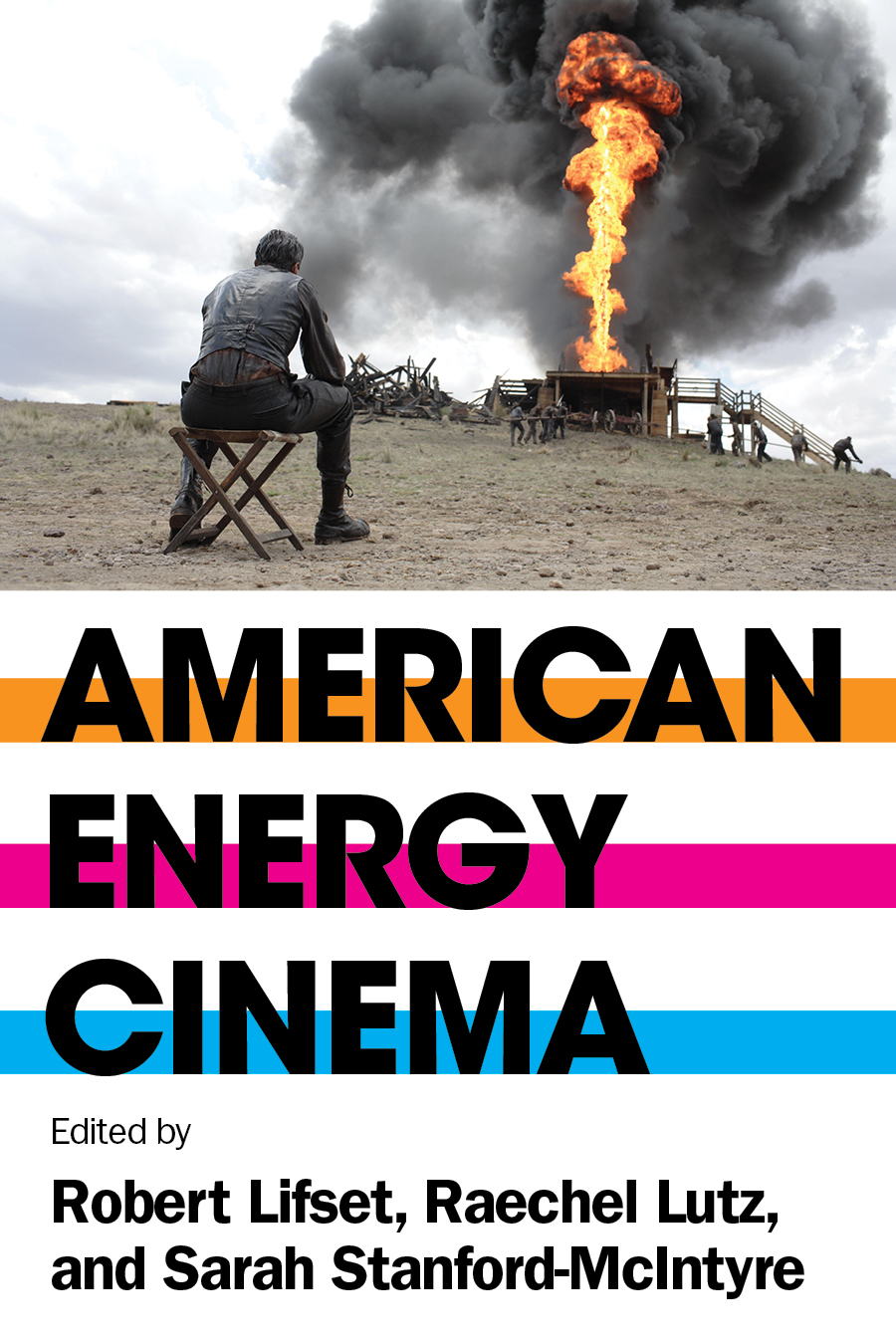
Edited by Robert Lifset, Raechel Lutz, and
Sarah Stanford-McIntyre
Available now!
376pp
PB 978-1-952271-76-2
$29.99
eBook 978-1-952271-77-9
$29.99
Energy and Society Series
American Energy Cinema explores how Hollywood movies have portrayed energy from the early film era to the present. Looking at classics like Giant, Silkwood, There Will Be Blood, and Matewan, and at quirkier fare like A Is for Atom and Convoy, it argues that films have both reflected existing beliefs and conjured new visions for Americans about the role of energy in their lives and their history.
The essays in this collection show how film provides a unique and informative lens to understand perceptions of energy production, consumption, and infrastructure networks. By placing films that prominently feature energy within historical context and analyzing them as historical objects, the contributing authors demonstrate how energy systems of all kinds are both integral to the daily life of Americans and inextricable from larger societal changes and global politics.
List of Illustrations
Introduction
Part 1: When Disaster Strikes
1. Blackouts, Bad Guys, and Belly Laughs: Exploring America’s First Cascading Power Failure in Where Were You When the Lights Went Out? (1968)
Julie A. Cohn
2. Meltdown: Nuclear Cinema and the Martha Mitchell Effect in The China Syndrome (1979) and Silkwood (1983)
Caroline Peyton
3. “The Juice”: The Road Warrior (1981) and the Cultural Logic of Energy Denial in the Early Days of Modern Globalization
Christopher R. W. Dietrich
4. Built for Pyro: A Perfect Inferno on the Deepwater Horizon (2016)
Tyler Priest
5. Chernobyl (2019): A Soviet Propaganda Win Delivered Thirty-Three Years Late
Kate Brown
Part 2: Energy and Nature
6. Wings (1927): Aviation, War, and Energy
Conevery Bolton Valencius
7. Derricks and Skulls: Filming and Promoting the Extractive Landscapes of Boom Town (1940)
Michaela Rife
8. Petrodocumentary in the 1940s: The Standard Oil Photography Project, Louisiana Story (1948), and the Domestication of the US Oil Industry
Emily Roehl
9. TVA and the Price of Progress: Elia Kazan’s Wild River (1960)
Donald C. Jackson
10. Do Action Movies and an Environmental Message Mix? About as Much as Oil and Water: On Deadly Ground (1994)
Teresa Sabol Spezio
Part 3: Critiquing the Western
11. Selling the American “Oil Frontier”: Tulsa (1949), Giant (1956), and American Resource Politics during the Early Cold War
Sarah Stanford-McIntyre
12. Ranches to Oil Wells: Reconfiguring the Western Hero in Hellfighters (1968) and Fires of Kuwait (1992)
Ila Tyagi
13. Revisiting Matewan (1987): Upending the Appalachian “Western” and Broadening an Old Labor Tale
James R. Allison III
14. “This Is the Third World”: Coal-Fired America in Montana (1990) and Powwow Highway (1989)
Ryan Driskell Tate
15. Hydrocarbon Nostalgia and Climate Disaster: An Environmental History of Hell or High Water (2016)
Mark Boxell
Part 4: Energy and Morality
16. Control of the Industry: Nineteenth-Century Oil and Capitalism in High, Wide and Handsome (1937)
Alexander Finkelstein
17. The Formula (1980): Corporate Villains, Synthetic Fuel, and Environmental Fantasies
Raechel Lutz
18. “Keep Moving”: Convoy (1978), Car Films, and Petropopulism in the 1970s
Caleb Wellum
19. There Will Be Petroleum Cinema: Portraying the Corrosion of Oil Addiction in There Will Be Blood (2007)
Brian C. Black
Part 5: Energy and the State
20. There’s No Business Like Oil Business: The Allure of Tax-Sheltered Oil Income to Hollywood’s Wealthy
Yuxun Willy Tan
21. “Limitless Power at Man’s Command”: A Is for Atom (1953), the Cold War, and Visions of the Nuclear Future in the 1950s
Sarah E. Robey
22. Syriana (2005): The Oil Curse and Hollywood’s 9/11 Film
Robert Lifset
23. Hoover Dam in Hollywood: Energy Anxiety in Superman (1978), Transformers (2007), and San Andreas (2015)
Daniel Macfarlane
Acknowledgments
Contributors
Index
Robert Lifset is the Donald Keith Jones Associate Professor of History in the Honors College at the University of Oklahoma and the author of Power on the Hudson: Storm King Mountain and the Emergence of Modern American Environmentalism. Raechel Lutz teaches history and civics at the Wardlaw+Hartridge School. Sarah Stanford-McIntyre is assistant professor of engineering, ethics, and society at the University of Colorado Boulder.
“A rich and compelling collection of essays covering a broad range of moments and films in the histories of oil, coal, nuclear power, and energy in America.”
Toby Jones, Rutgers University
“Movies are a fun escape from reality, cultural snapshots in time, and valuable historical documents. That’s the key thesis and value of this book: it gives readers an engaging way to learn the history of energy—rather, the history of American society—with a century of thrillers, dramas, comedies, and whodunits. Addressing a range of genres, story lines, and themes, this collection of essays will be captivating and informative for movie lovers, energy enthusiasts, and historians alike.”
Michael E. Webber, host and creator of the PBS special Energy at the Movies
You are being redirected to The Chicago Distribution Center.
West Virginia University Press is not responsible for content on external sites.
