American Grief in Four Stages: Stories


Sadie Hoagland

November 2019
168pp
PB 978-1-949199-21-5
$18.99
eBook 978-1-949199-22-2
$18.99

Summary

American Grief in Four Stages is a collection of stories that imagines trauma as a space in which language fails us and narrative escapes us. These stories play with form and explore the impossibility of elegy and the inability of our culture to communicate grief, or sympathy, outside of cliché.

One narrator, for example, tries to understand her brother’s suicide by excavating his use of idioms. Other stories construe grief and trauma in much subtler ways—the passing of an era or of a daughter’s childhood, the seduction of a neighbor, the inability to have children. From a dinner party with Aztecs to an elderly shut-in’s recollection of her role in the Salem witch trials, these are stories that defy expectations and enrich the imagination. As a whole, this collection asks the reader to envisage the ways in which we suffer as both unbearably painful and unbearably American.

Contents

Cavalier Presentations of Heartbreaking News

Fucking Aztecs                                                                                                                              
In July Flags Are Everywhere                                                                                                       
Father/Writer                                                                                                                                  
Warning Signs                                                                                                                              
American Family Portrait, Clockwise from Upper Right                                                            
The Crossword                                                                                                                             
Frog Prince                                                                                                                                     
Six and Mittens                                                                                                                               
American Grief in Four Stages                                                                                                    
Origins                                                                                                                                          
Extra Patriotic                                                                                                                              
Prelingual                                                                                                                                    
Dementia, 1692                                                                                                                           
Time Just Isn’t That Simple                                                                                                     
Acknowledgements

Author

Sadie Hoagland is an assistant professor of English at the University of Louisiana at Lafayette and the former editor of Quarterly West. Her work has appeared in Alice Blue Review, The Black Herald, Mikrokosmos Journal, South Dakota Review, Sakura Review, Grist, Oyez Review, Passages North, Five Points, The Fabulist, and elsewhere. Learn more at sadiehoagland.com.

Reviews

"A captivating debut collection probes the trauma of being human. . . . assured, haunting, and deeply empathetic."
Kirkus (starred review)

"This terrifying, brave collection takes the sting out of what happens when the worst has already occurred. Even in their loss, its broken characters find ways to try and explain the unexplainable to themselves."
Foreword Reviews

“Sadie Hoagland’s stories are hard and bright as the twenty-first century, but with reflections that radiate into subtle chiaroscuro. She’s a startlingly fresh new writer; American Grief in Four Stages is a debut that will be remembered.”
Madison Smartt Bell, author of All Souls’ Rising

“Terrifyingly true and dangerously perceptive, Sadie Hoagland’s provocative fictions deliver us to moments of maximum chaos.”
Melanie Rae Thon, author of Silence and Song

“As riveting as short fiction gets.”
Jacob M. Appel, author of The Amazing Mr. Morality

EmailFacebookInstagramPinterestTwitter

Fatherless: A Memoir


Keith Maillard

October 2019
240pp
PB 978-1-949199-13-0
$23.99
eBook 978-1-949199-14-7
$23.99

Summary

This story begins with a phone call out of the blue: a lawyer tells a writer that his ninety-six-year-old father, with whom he has had no contact since the age of three and whom he has twice tried to find without success, has just died, leaving him nothing. Half-reluctant, half-fascinated, both angry and curious, Keith Maillard begins to research his father’s life. The result is a suspenseful work of historical reconstruction—a social history often reading like a detective story—as well as a psychologically acute portrait of the impact of a father’s absence. Walking a tightrope between the known and the unknown, and following a trail that takes him from Vancouver to Montreal to his native Wheeling, West Virginia, Keith Maillard has pulled off a book that only a novelist of his stature could write.

Contents

Coming soon.

Author

Keith Maillard is the author of fourteen novels, most recently Twin Studies, the winner of the Alberta Book of the Year Award in Fiction. Born and raised in West Virginia, he has lived in Vancouver for most of his adult life. He has been a musician, photographer, and journalist, and has taught creative writing at the University of British Columbia since 1989.

Reviews

“This memoir is an astonishing act of generosity and tenacity, exploring the profound flaws of one family’s dynamics and the resiliency of the human spirit.”
Eden Robinson, author of Son of a Trickster

Fatherless is Keith Maillard’s haunting response to that most ancient curse: Why, father, did you desert me? How, father, should I love you?”
Clark Blaise, author of I Had a Father

“Marvelous and brutally honest.”
Marc Harshman, author of Woman in Red Anorak and poet laureate of West Virginia

EmailFacebookInstagramPinterestTwitter

Mountains Piled upon Mountains: Appalachian Nature Writing in the Anthropocene


Edited by Jessica Cory

August 2019
360pp
PB 978-1-946684-90-5
$27.99
eBook 978-1-946684-91-2
$27.99

Summary

Mountains Piled upon Mountains features nearly fifty writers from across Appalachia sharing their place-based fiction, literary nonfiction, and poetry. Moving beyond the tradition of transcendental nature writing, much of the work collected here engages current issues facing the region and the planet (such as hydraulic fracturing, water contamination, mountaintop removal, and deforestation), and provides readers with insights on the human-nature relationship in an era of rapid environmental change.

This book includes a mix of new and recent creative work by established and emerging authors. The contributors write about experiences from northern Georgia to upstate New York, invite parallels between a watershed in West Virginia and one in North Carolina, and often emphasize connections between Appalachia and more distant locations. In the pages of Mountains Piled upon Mountains are celebration, mourning, confusion, loneliness, admiration, and other emotions and experiences rooted in place but transcending Appalachia’s boundaries.


Add bundle to cart

Contents

Chris Bolgiano
Taylor Brown
Ben Burgholzer 
Kathryn Stripling Byer
Wayne Caldwell 
Sarah Beth Childers
Jessica Cory
Chauna Craig
Thomas Rain Crowe
Stephen Cushman
doris diosa davenport
Ed Davis
Susan Deer Cloud
Lisa Ezzard
Katie Fallon
Carol Grametbauer 
Jesse Graves
Jane Harrington
Lisa Hayes-Minney
Laura Henry-Stone
Scott Honeycutt
George Hovis
Gene Hyde
Libby Falk Jones
Madison Jones 
Julia Spicher Kasdorf
Bill King
John Lane
Jeanne Larsen
Laura Long
Brent Martin
Michael McFee
Jim Minick
Felicia Mitchell
Ann Pancake
Ellen J. Perry
Mark Powell
Heather Ransom
Jeremy Michael Reed
John Robinson
Rosemary Royston
M. W. Smith
Larry D. Thacker
Gail Tyson
Rick Van Noy
G. C. Waldrep
Meredith Sue Willis
Amber M. Wright
David R. Young

Editor

Jessica Cory teaches in the English department at Western Carolina University. She grew up in southeastern Ohio, and her work has been published in ellipsis…, A Poetry Congeries, and other journals.

Reviews

Mountains Piled upon Mountains is a collection of writings that does more than record the observations of Appalachian authors on their environment. It is also a timely call to action: to preserve what might be lost and, most hopefully, what might yet be resurrected. Jessica Cory has given us an important addition to our region’s literature.”
Ron Rash, author of Above the Waterfall

“From the introduction onward, this collection, filled with bright surprises and sharp challenges, engaged my emotions, mind, and senses. Taking in its life-giving poems, heart-piercing stories, and ethically profound essays, night after night I pondered this collection, drank in Appalachia and nature, and felt my sense of wonder and connection renewed.”
Chris Green, director of the Loyal Jones Appalachian Center, Berea College

EmailFacebookInstagramPinterestTwitter

Education and Treatment of Children, Vol 41

Education and Treatment of Children

Editor: Dr. Bernie Fabry
E-ISSN: 0748-8491
Frequency: Quarterly
Click on listed price to corresponding product to order:
Volume 41: Institution (US): $100.00
Volume 41: Individual (US): $50.00
Volume 41: International Institution (Outside US): $115.00
Volume 41: International Individual (Outside US): $65.00
 

Victorian Poetry: Volume 56, Issues 1-4


Image

Victorian Poetry: Volume 56, Issues 1–4
Editor: John B. Lamb, West Virginia University
E-ISSN: 1530-7190
Print ISSN: 0042-5206

Click on listed price to corresponding product to order:
Institution (US): $110.00
Individual (US): $50.00
Institution (Outside US, including Canada): $130.00
Individual (Outside US, including Canada): $75.00


Modern Moonshine: The Revival of White Whiskey in the Twenty-First Century

Edited by Cameron D. Lippard and Bruce E. Stewart

252pp
PB 978-1-946684-82-0
$29.99
CL 978-1-946684-81-3
$99.99
eBook 978-1-946684-83-7
$29.99


Summary

The craft of making moonshine—an unaged white whiskey, often made and consumed outside legal parameters—nearly went extinct in the late twentieth century as law enforcement cracked down on illicit producers, and cheaper, lawful alcohol became readily available. Yet the twenty-first century has witnessed a resurgence of artisanal distilling, as both connoisseurs and those reconnecting with their heritage have created a vibrant new culture of moonshine. While not limited to Appalachia, moonshine is often entwined with the region in popular understandings.

The first interdisciplinary examination of the legal moonshine industry, Modern Moonshine probes the causes and impact of the so-called moonshine revival. What does the moonshine revival tell us about our national culture? How does it shape the image of Appalachia and rural America? Focusing mostly on southern Appalachia, the book’s eleven essays chronicle such popular figures as Popcorn Sutton and explore how and why distillers promote their product as “traditional” and “authentic.” This edited collection draws from scholars across the disciplines of anthropology, history, geography, and sociology to make sense of the legal, social, and historical shifts behind contemporary production and consumption of moonshine, and offers a fresh perspective on an enduring topic of Appalachian myth and reality.

Editors

Bruce E. Stewart is an associate professor of history at Appalachian State University. He is the author or editor of several books, including Moonshiners and Prohibitionists: The Battle over Alcohol in Southern Appalachia.

Cameron D. Lippard is a professor of sociology at Appalachian State University. He is the author or editor of several books, including Building Inequality: Race, Ethnicity, and Immigration in the Atlanta Construction Industry and Untapped: Exploring the Cultural Dimensions of Craft Beer (West Virginia University Press).


Contents

List of Illustrations      

Introduction: The Revival of Moonshine in Southern Appalachia and the United States     

Bruce E. Stewart and Cameron D. Lippard

Part I: Socially Constructing the Origins of the Modern Moonshine Revival

1. Fire Up the Stills: A Brief History of Moonshining in Southern Appalachia before the Twenty-First Century   

Bruce E. Stewart

2. Jim Tom Hedrick, Popcorn Sutton, and the Rise of the Postmodern Moonshiner

Daniel S. Pierce

3. Moonshiners and the Media: The Twenty-First-Century Trickster          

Emily D. Edwards

4. Making Criminals, Making Ends Meet: Constructing Criminality in Franklin County, Virginia

Robert T. Perdue

Part II: The Legalization and Marketing of Modern Moonshine

5. The Rise of “Legal” Moonshine: Breaking Down the Legal Barriers to Craft Distilling in the United States    

Kenneth J. Sanchagrin

6. From the Appalachian Mountains to the Puget Sound and Beyond: Distilling Authenticity in Modern Moonshine       

Kaitland M. Byrd, J. Slade Lellock, and Nathaniel G. Chapman

7. Entrepreneurial Family Values and the Modern Moonshiner: Appalachian Craft Distilling beyond Its Neoliberal Frame         

Jason Ezell

8. The “Uncatchables”: A Case Study of Call Family Distillers in Wilkes County, North Carolina

Cameron D. Lippard

Part III: Historic Preservation and Tourism in the Name of Moonshine

9. Distilling Commercial Moonshine in East Tennessee: Mashing a New Type of Tourism           

Helen M. Rosko

10. Heritage Spirits in Heritage Spaces        

Kristen Baldwin Deathridge

11. Automotive Heritage and the Legacy of High-Octane Moonshiners: A Unique Cultural Intersection of Alcohol and Motor Vehicles            

Barry L. Stiefel

Contributor Biographies         

Reviews

“I like this book very much. The editors have brought together a wide range of scholarly voices, and their essays, taken together, give an excellent overview of the state of modern moonshine.”
Michael Lewis, author of The Coming of Southern Prohibition


EmailFacebookInstagramPinterestTwitter

Governing the Wind Energy Commons: Renewable Energy and Community Development

Keith A. Taylor

Rural Studies Series
July 2019
180pp
PB 978-1-946684-85-1
$29.99
eBook 978-1-946684-86-8
$29.99


Summary

Wind energy is often framed as a factor in rural economic development, an element of the emerging “green economy” destined to upset the dominant greenhouse- gas-emitting energy industry and deliver conscious capitalism to host communities. The bulk of wind energy firms, however, are subsidiaries of the same fossil fuel companies that wrought havoc in shale-gas and coal-mining towns from rural Appalachia to the Great Plains. On its own, wind energy development does not automatically translate into community development.

In Governing the Wind Energy Commons, Keith Taylor asks whether revenue generated by wind power can be put to community well-being rather than corporate profit. He looks to the promising example of rural electric cooperatives, owned and governed by the 42 million Americans they serve, which generate $40 billion in annual revenue. Through case studies of a North Dakota wind energy cooperative and an investor-owned wind farm in Illinois, Taylor examines how regulatory and social forces are shaping this emerging energy sector. He draws on interviews with local residents to assess strategies for tipping the balance of power away from absentee-owned utilities.

Author

Keith A. Taylor is community economic development specialist faculty in the department of human ecology at the University of California, Davis. He holds a PhD in human and community development from the University of Illinois at Urbana-Champaign

Contents

Introduction

Community Development & Institutional Fit

Case Study - The Investor-Owned Wind Farm

Case Study - The Co-operative-Owned Wind Farm

Comparing the Investor & Co-operative Owned Firms

Why Not Policy From Below?

Reviews

“This is a groundbreaking work that addresses the potential and limitations of alternative economic models for delivery of a key service: electricity.”
Cornelia Flora, Iowa State University


EmailFacebookInstagramPinterestTwitter

Smell and History: A Reader

Edited by Mark M. Smith

264pp
PB 978-1-946684-68-4
$26.99
eBook 978-1-946684-69-1
$26.99


Summary

Smell and History collects many of the most important recent essays on the history of scent, aromas, perfumes, and ways of smelling. With an introduction by Mark M. Smith—one of the leading social and cultural historians at work today and the preeminent champion in the United States of the emerging field of sensory history—the volume introduces to undergraduate and graduate students as well as to historians of all fields the richness, relevance, and insightfulness of the olfactory to historical study.

Ranging from antiquity to the present, these ten essays, most of them published since 2003, consider how olfaction and scent have shaped the history of medicine, gender, race-making, class formation, religion, urbanization, colonialism, capitalism, and industrialization; how habits and practices of smelling informed ideas about the Enlightenment, modernity, and memory; how smell shaped perceptions of progress and civilization; and how people throughout history have used smell as a way to organize categories and inform worldviews.

Contents

Editor’s Introduction: Smelling the Past | Mark M. Smith    

Introduction: Why Smell the Past? | Alain Corbin    

1.         Scent and Sacrifice in the Early Christian World | Susan Ashbrook Harvey 

2.         Urban Smells and Roman Noses | Neville Morley     

3.         Medieval Smellscapes | C. M. Woolgar        

4.         Smelling the New World | Holly Dugan        

5.         Gender, Medicine, and Smell in Seventeenth-Century England | Jennifer Evans     

6.         Smell and Victorian England | Jonathan Reinarz     

7.         Reodorizing the Modern Age | Robert Jütte   

8.         Making “Others” Smell | Mark M. Smith      

Epilogue: Futures of Scents Past | David Howes      

Acknowledgments     

Further Reading          

Sources and Permissions       

Index  

Author

Mark M. Smith is Carolina Distinguished Professor of History at the University of South Carolina. His work has been featured in the New York Times, the Wall Street Journal, and the New York Review of Books, and he serves as the general editor of Interdisciplinary Perspectives on Sensory History.

Reviews

“An important overview of this burgeoning new field, compiled by one of its most insightful scholars.”
Peter Denney, Griffith University

EmailFacebookInstagramPinterestTwitter

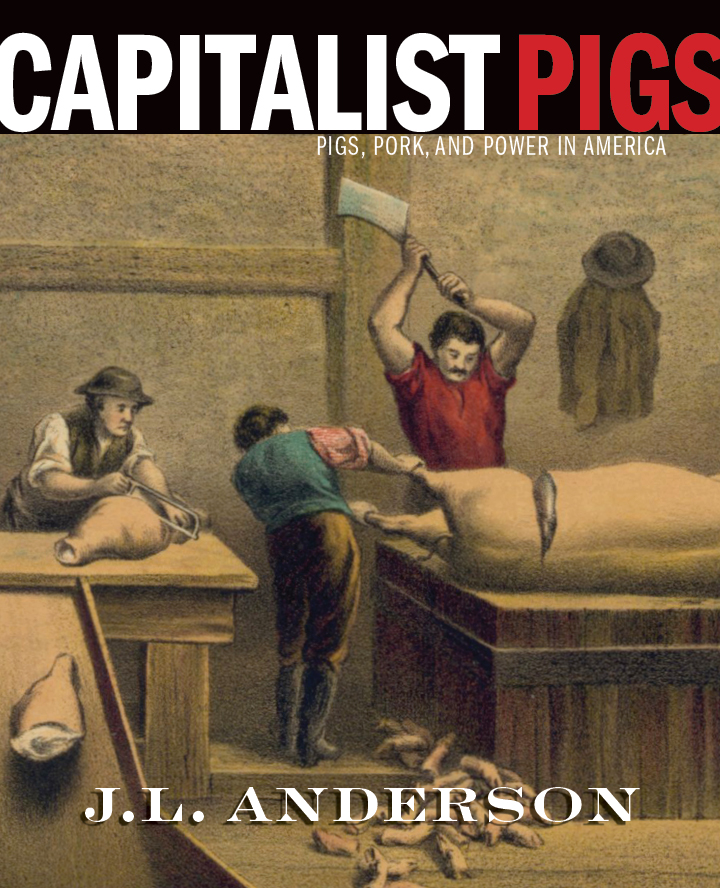
Capitalist Pigs: Pigs, Pork, and Power in America

J. L. Anderson

300pp 
PB 978-1-946684-73-8
$34.99
CL 978-1-946684-72-1
$99.99
eBook 978-1-946684-74-5
$34.99


Summary

Pigs are everywhere in United States history. They cleared frontiers and built cities (notably Cincinnati, once known as Porkopolis), served as an early form of welfare, and were at the center of two nineteenth-century “pig wars.” American pork fed the hemisphere; lard literally greased the wheels of capitalism.

J. L. Anderson has written an ambitious history of pigs and pig products from the Columbian exchange to the present, emphasizing critical stories of production, consumption, and waste in American history. He examines different cultural assumptions about pigs to provide a window into the nation’s regional, racial, and class fault lines, and maps where pigs are (and are not) to reveal a deep history of the American landscape. A contribution to American history, food studies, agricultural history, and animal studies, Capitalist Pigs is an accessible, deeply researched, and often surprising portrait of one of the planet’s most consequential interspecies relationships.

Contents

List of Illustrations      

Acknowledgments     

Introduction    

1. Making American Gehography     

2. Hogs at Home on the Range           

3. Working People’s Food      

4. Pigs and the Urban Slop Bucket     

5. To Market, to Market       

6. Swine Plagues     

7. Making Bacon and White Meat     

8. Science and the Swineherd 

Coda: The Future of Hogs in America            

Notes   

Index   

Author

J. L. Anderson teaches history at Mount Royal University in Calgary, Alberta. Prior to his academic appointment, he was a museum educator and administrator, cultivating a personal and professional interest in swine at the agricultural museums where he worked. Anderson is currently president of the Agricultural History Society.

Reviews

"In the vein of William Cronon’s Nature’s Metropolis, this is a meaty, accessible, and clear-eyed agricultural history."
Booklist

"Anderson delivers the most thorough account of American pigs ever written, a book packed with fascinating detail on where pigs lived (forests, farmyards, city streets), what they ate (nuts, corn, garbage, the corpses of Civil War soldiers), and how scientists transformed their bodies and their lives to meet the relentless demands of the market. This is the story of how pigs made America, and how America remade the pig."
Mark Essig, author of Lesser Beasts: A Snout-to-Tail History of the Humble Pig

“J.L. Anderson weaves a complex story about the hog industry’s impact on the growth of an economy and offers insight into the important role the agriculture and food industry played in the building of a nation. You will find yourself surprised by its influence."
Tom Vilsack, US Secretary of Agriculture, 2009–2017

"J. L. Anderson's Capitalist Pigs is a thorough and engaging examination of swine in US agriculture, culture, and history. It will be a standard to judge later histories of Americans' relationships with agricultural livestock and domestic animals."
Leo Landis, State Curator, State Historical Society of Iowa and "the Bacon Professor"

“A sweeping history of pigs in the United States from before the arrival of Europeans to today. In Anderson’s clear, brisk, and clever history, these animals appear as wild beasts roaming forests, domesticates in farm pens, commodities in railcars, corpses on slaughterhouse hooks, meat at the ends of butchers’ knives, consumer products in Walmart coolers, nourishment in human stomachs, and as transplanted hearts thumping away in human chests. It’s fun to read.”
James C. Giesen, author of Boll Weevil Blues: Cotton, Myth, and Power in the American South

"Anderson’s investigation is thorough, focusing on economic and social impacts, and, when appropriate, unflinching."
Publishers Weekly

"A clear and accessible read, beautifully illustrated with paintings, maps, and photographs that demonstrate the prominence of the pig in America."
Environmental History

"Valuable for scholars and ac­cessible to a broad audience."
The Annuals of Iowa

EmailFacebookInstagramPinterestTwitter